Blog
Custom Perfume Packaging Cost: What Affects the Price? (2026 Guide)
Custom Perfume Packaging Cost: What Affects the Price?
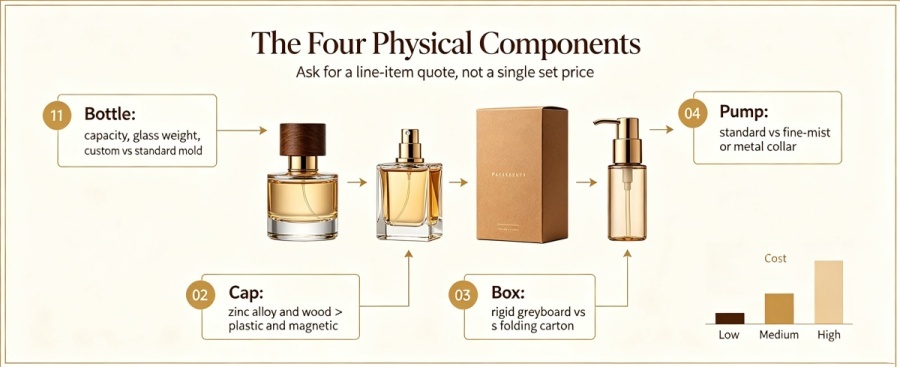
Five factors drive custom perfume packaging cost — materials, decoration, tooling (molds), order volume, and add-ons such as compliance testing and freight. The single lever you control most is volume: per-unit custom perfume packaging cost drops sharply as MOQ rises, because tooling and setup get amortized across more units.
Before you compare quotes, know what you are paying for. The global perfume and fragrance packaging market is projected at roughly US$7.7 billion in 2026, growing about 5.8% per year through 2033 — which is why packaging is increasingly treated as an investment in shelf appeal, not a line item to minimize. This guide breaks down every cost component in custom perfume packaging, shows how each one scales with volume, and tells you exactly what to send a supplier to get an accurate quote the first time.
1. The four physical components: bottle, cap, box, pump
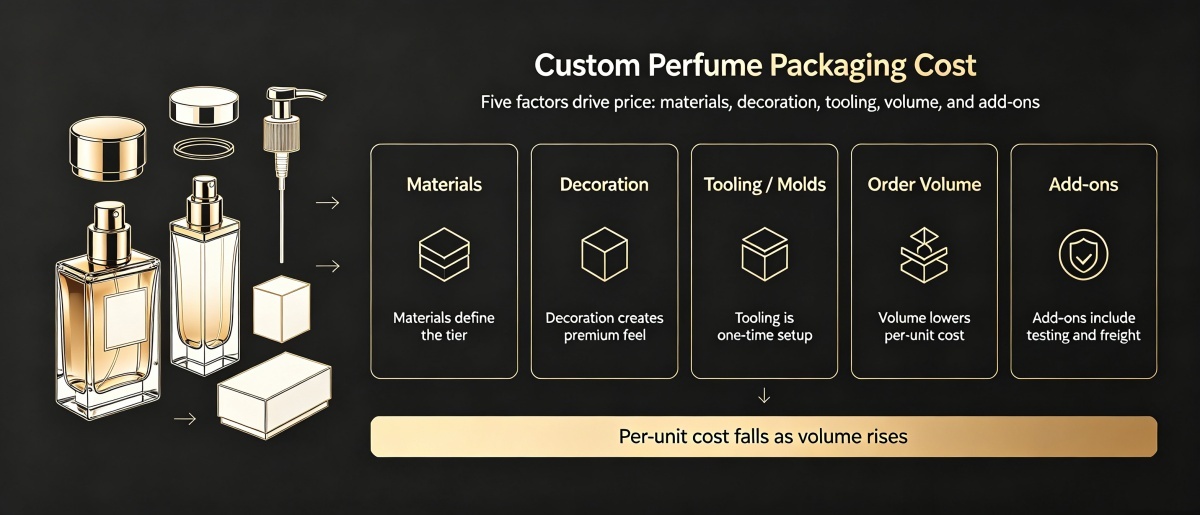
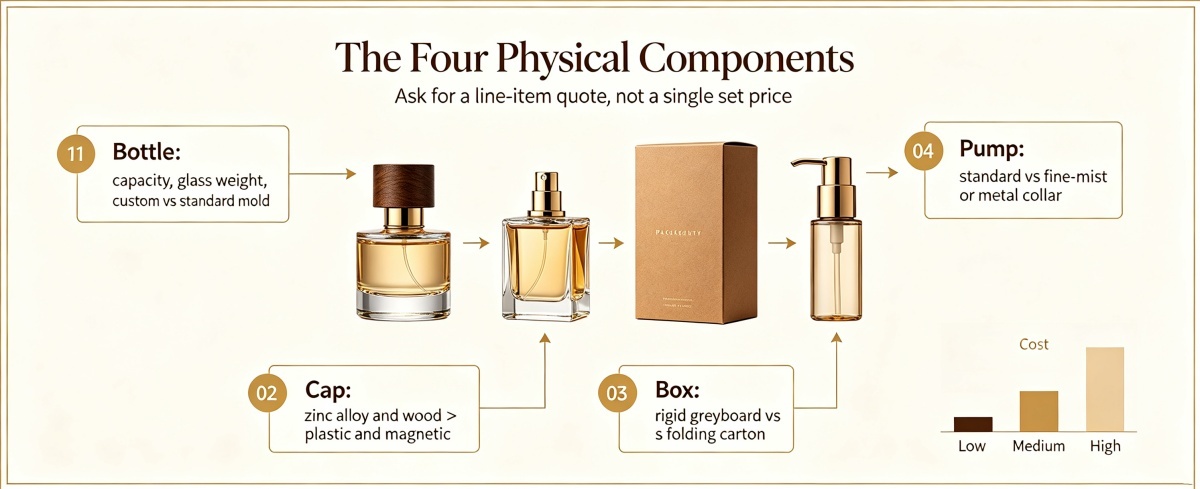
A perfume set is really four products in one, and each has its own price ladder — so ask for a line-item quote per component, not a single "set price".
- Bottle. Glass dominates. Price scales with capacity, glass weight, and whether you use a standard or custom mold.
- Cap. Material decides the tier: zinc alloy and wood sit above plastic and magnetic caps.
- Box. Rigid boxes (greyboard) cost more than folding cartons, and box decoration adds on top.
- Pump. A standard pump is inexpensive; fine-mist, metal-collar or custom-color pumps cost more.
A line-item breakdown for a full custom perfume packaging set shows you where the money goes — and where you can trim without hurting the look.
2. Material is the biggest single driver
In most sets, material outweighs labor. Glass quality and weight move the bottle price; cap material moves the cap price; box board thickness and texture move the box price. Plastic is the budget route, glass the standard, and zinc alloy or wood the premium route for caps.
The rule of thumb: every time you upgrade a material, you add a step upstream — better raw stock, longer machining, stricter QC. For custom perfume packaging, material choices typically account for the largest share of the gap between a budget set and a luxury set.
3. Decoration: where the visible cost goes
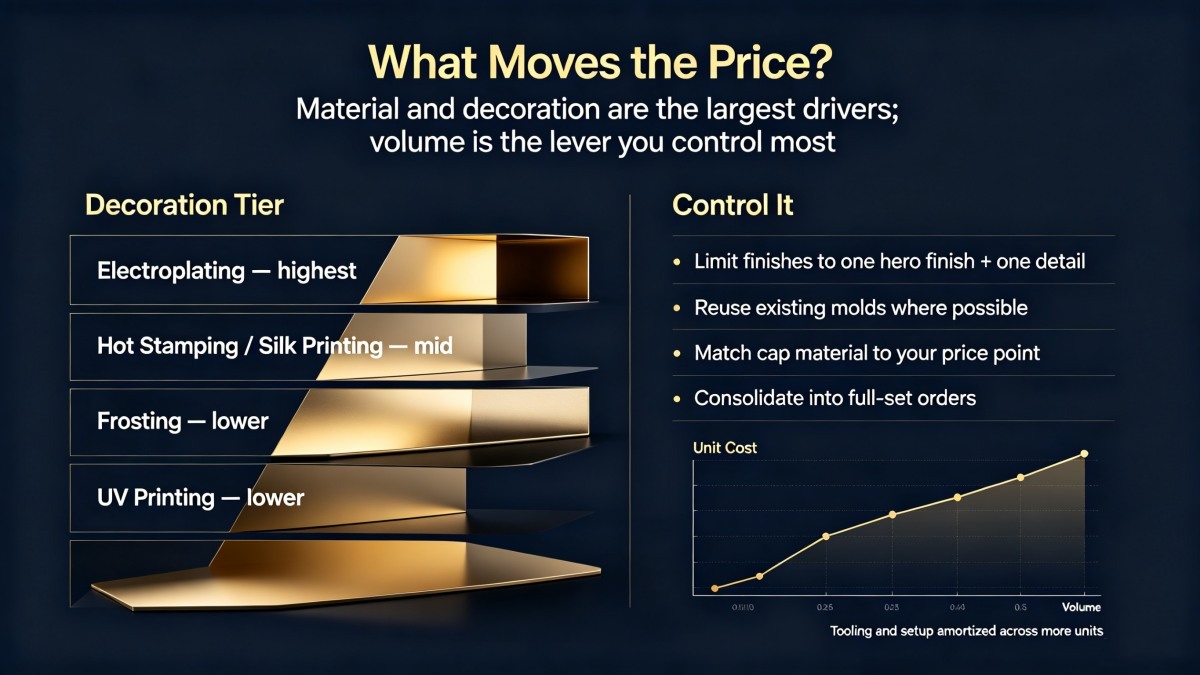
Decoration is the fastest way to make a bottle look premium — and the second-largest cost driver. As a rough ranking:
- Electroplating is the most expensive finish, common on zinc alloy caps.
- Hot stamping and silk printing sit in the middle; they add definition and brand detail.
- Frosting and UV printing are lower-cost finishes that still change the feel completely.
Each finish adds a process step and often a per-part charge. Limiting the number of finishes per set — say one hero finish plus one detail — is the fastest way to control cost without losing the premium look.
4. Tooling and molds: the one-time cost buyers forget
Custom shapes require molds, and molds cost real money — a one-time charge for bottle, cap and box tooling. Two questions matter: who owns the mold once it is paid for, and over how many units it is amortized. The same mold spread over 5,000 units adds far more to your unit price than over 50,000 units.
If you are on a budget, ask which existing molds the supplier already has. Reusing an existing mold with a new decoration can remove the biggest one-time line from your custom perfume packaging quote.
5. Volume and MOQ: the lever you actually control
Per-unit custom perfume packaging cost falls with volume because fixed costs — tooling, setup, printing plates — are spread across more units. Expect tiered pricing: the unit price at 3,000 units, 10,000 units and 30,000 units will be different.
Two practical moves: consolidate components into one full-set order (this often earns better pricing than four separate orders), and pick a quantity that matches your sales forecast so you reach a lower tier without overstocking.
6. The hidden costs buyers forget
Beyond the four components, a complete custom perfume packaging quote should budget for:
- Artwork and setup fees for printing and decoration.
- Protective packaging for fragile glass — and breakage risk in transit.
- Freight — sea vs air can change the landed cost significantly.
- Customs and duties in the destination country.
- Compliance documentation — for example, U.S. FDA facility registration and product listing under the Modernization of Cosmetics Regulation Act (MoCRA), or EU notification under the Cosmetics Regulation (EC) No 1223/2009.
- Payment fees, and sometimes sample shipping or testing charges.
A transparent supplier puts all of these in writing. If a quote shows only the four components, ask for the rest before you compare suppliers.
Cost comparison table: what moves the price
Cost driver | What drives it | Relative cost | How to control it |
Glass bottle | capacity, glass weight, custom vs standard mold | Low–Medium | standard capacities, reuse molds |
Cap | zinc alloy > wood > plastic / magnetic | Low–High | match cap tier to your price point |
Box | rigid vs folding carton, board, decoration | Low–Medium | rigid for premium, folding for budget |
Pump | standard vs fine-mist / metal collar | Low | standard pump |
Decoration | electroplating > hot stamping / silk printing > frosting / UV | Medium–High | one hero finish + one detail |
Tooling | new molds, one-time | High (one-time) | reuse existing molds |
Volume | MOQ and tiered pricing | — | consolidate into full-set orders |
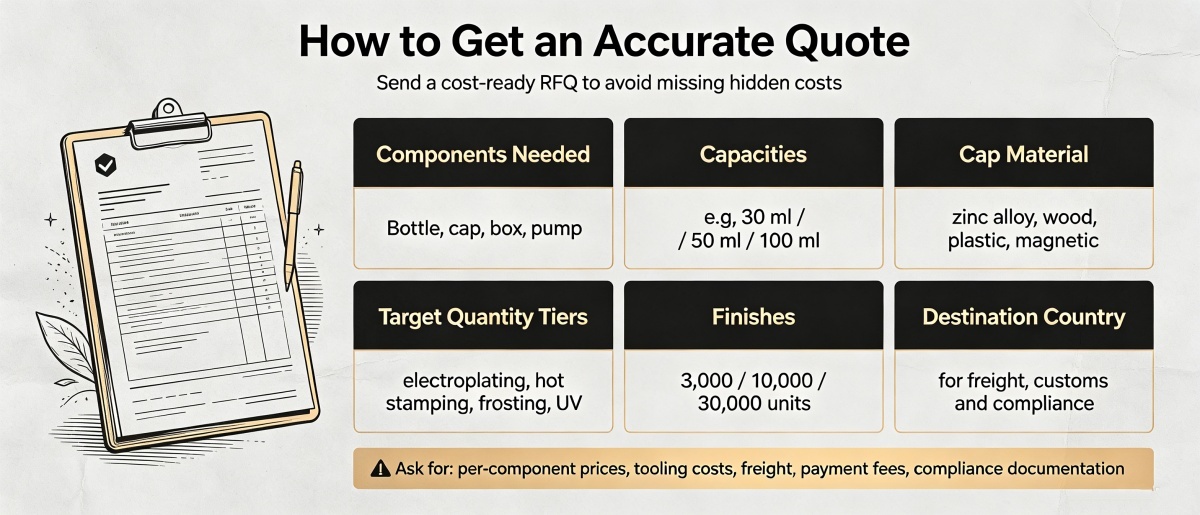
How to get an accurate quote
Send a cost-ready RFQ — not "how much for perfume packaging?" Include: components needed, capacities (e.g., a 50 ml bottle), cap material, finishes, target quantity tiers (3,000 / 10,000 / 30,000), and destination country for freight. With that information, a supplier can quote per-component prices, tooling costs and freight in one round.
Ready for a line-item custom perfume packaging quote? Request a custom quote and include your components, quantities and destination — our team replies within 24 hours. Or reach us directly on WhatsApp.
FAQ
How much does custom perfume packaging cost?
It depends on five variables: material, decoration, tooling, volume and add-ons. As an indicative benchmark, a standard set at scale costs far less per unit than a premium set with a zinc alloy cap and electroplating — and per-unit price falls as quantity rises. Ask for tiered, line-item quotes rather than a single price.
Why is perfume packaging so expensive?
Because it is a materials and finishing game — custom glass, metal caps, rigid boxes and multi-step decoration each add processes and quality control. The premium look is literally built from more expensive steps.
Can I reuse an existing mold to save money?
Yes. If the supplier has a standard mold in your shape and capacity, you can skip or heavily reduce the one-time tooling charge and spend your budget on decoration instead.
Does MOQ affect the price?
Directly. Higher MOQs spread tooling and setup costs across more units, so per-unit custom perfume packaging cost falls. Always ask for prices at two or three quantity tiers.
What hidden costs should I ask about?
Artwork setup, protective packaging for glass, freight (sea vs air), customs duties, compliance documentation and payment fees. Ask for a full written breakdown before committing.
0users like this.