Blog
10ml Spray Bottles Wholesale: A Simple Buying Guide for Small Businesses
Ordering 10ml spray bottles wholesale sounds simple—until you open the first box and realize the sprayers do not fit the bottles, the mist is uneven, or the final cost is far higher than the unit price you were quoted. These mistakes are common, and they usually come from focusing only on the lowest price. Seasoned buyers know that packaging problems tend to surface only after the order is already in your hands—and by then, the money is spent.
This guide helps you avoid those problems. You will learn how to choose between plastic and glass, evaluate sprayer types, compare suppliers, calculate hidden costs, and test samples before you commit to a bulk order. Use this as a practical roadmap for your first wholesale purchase of 10ml spray bottles.
Key Takeaways:
- Match the bottle material and sprayer type to your specific product, not just your budget.
- Always request a full written quote that includes shipping, tariffs, defect terms, and replacement policies.
- Test samples with the actual product you plan to fill before ordering in bulk.
- Factor in total landed cost—not just unit price—when comparing suppliers.
Why Your 10ml Spray Bottle Choice Affects Your Product
Your bottle choice is not just a packaging decision—it is part of the product experience. A sprayer that leaks or a bottle that feels cheap can make a good formula look unprofessional. Buying wholesale also does not mean every supplier offers the same quality, even when the bottles look identical in photos.
Where 10ml Spray Bottles Are Most Commonly Used
You will see 10ml spray bottles in several product categories. They are popular for travel-size facial mists, essential oil blends, sanitizing sprays, perfume samples, and small-batch cosmetics. The compact size works well for trial kits, subscription boxes, and retail counter displays. Because customers often carry these bottles in bags or pockets, durability and leak resistance matter more than they would for a larger bottle.
Why 'Wholesale' Does Not Mean One-Size-Fits-All
Wholesale pricing simply means you are buying in larger quantities. It does not guarantee consistent quality, reliable sprayers, or complete specifications. Two suppliers may both sell "10ml PET spray bottles," but one may use thinner plastic, a cheaper sprayer, or a different neck finish. When you compare wholesale options, compare full specifications—not just the unit price.
Here is what experienced importers understand that first-time buyers often miss: a supplier's listed product photo is frequently a stock image, not a photo of the actual batch you will receive. The bottle in the photo may be a premium sample from years ago, while the current production run uses a lighter preform or a lower-cost sprayer. This is why written specifications matter more than images. If the supplier cannot tell you the bottle's gram weight, the plastic resin grade, or the sprayer's output volume in writing, you are comparing pictures—not products.
Plastic vs. Glass: Choosing the Right Material for Your Product
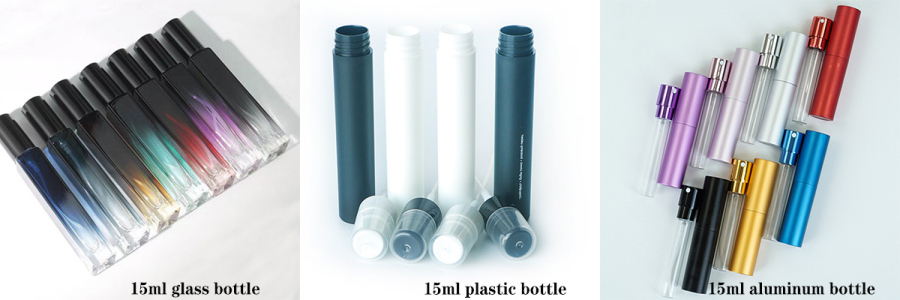
Start with the material because it affects shipping cost, product safety, and how customers perceive your brand. For most small businesses, the choice comes down to PET plastic or glass. Each has clear advantages depending on what you are filling.
PET Plastic: Lightweight and Budget-Friendly
PET plastic is the most common choice for 10ml spray bottles. It is lightweight, shatter-resistant, and usually cheaper to buy and ship. For water-based mists, sanitizers, and travel products, PET works well and reduces the risk of breakage during delivery. If your product contains essential oils or strong solvents, check with the supplier about chemical compatibility. Some oils can degrade certain plastics over time.
The commercial reason PET dominates the 10ml category is simple economics: shipping cost is calculated by weight and carton volume, and plastic bottles stack tighter and weigh less than glass. This means the same container of product ships more units per dollar. But there is a less obvious trade-off. Cheaper PET bottles are often produced with thinner wall sections to save resin—which saves the supplier money at your expense. A thin-walled bottle can deform when squeezed, crack at the neck during capping, or collapse slightly under a tight sprayer. When evaluating samples, hold the empty bottle between your thumb and index finger and squeeze. If it flexes easily, ask the supplier about wall thickness in millimeters before placing a bulk order.
Glass: Premium Feel but Higher Shipping Weight
Glass gives a premium look and feel—ideal for perfumes, luxury facial mists, and high-end product samples. Glass also avoids concerns about plastic leaching or reacting with certain formulas. However, glass weighs more, which raises shipping cost, and it has a higher risk of breakage. If you choose glass spray bottles, budget extra for protective packaging and confirm the supplier's breakage replacement policy before ordering.
One practical example: a small skincare brand selling a $38 facial mist can absorb the higher shipping cost of glass because the premium packaging supports the retail price. But a business selling a $6 travel sanitizer spray likely cannot afford the freight and breakage overhead of glass—and the customer is not expecting it. Let your price point and channel guide the material choice. If you sell online and ship individual bottles to customers, the breakage risk of glass multiplies across every single shipment. If you sell wholesale to retail stores, glass may hold up fine in case packs but still needs partitions or foam padding inside the master carton.
Sprayer Types and Finish: What Actually Matters
The bottle gets attention, but the sprayer determines whether the product works as intended. A bad sprayer can ruin the customer experience even if the bottle itself is fine. Pay close attention to sprayer style and neck compatibility before placing a bulk order.
Fine Mist vs. Standard Spray Heads
A fine mist sprayer produces a soft, even mist—good for facial toners, setting sprays, and sanitizing mists. A standard spray head may deliver a wetter, less uniform spray. Do not assume all sprayers are the same. For products applied to the face or hair, a fine mist sprayer usually performs better. For thicker formulas, a standard spray head or a sprayer with a larger output may be more practical. Always test the sprayer with your actual product rather than water, because formula viscosity changes spray performance.
Here is why viscosity matters more than most beginners realize. A fine mist sprayer works by forcing liquid through a narrow orifice under pressure. Water passes through easily and breaks into small droplets. But a product that is even slightly thicker—say a gel-based toner or an oil blend—will not atomize the same way. The spray may come out as a stream or sputter unevenly. In some cases, the formula can clog the sprayer after drying, especially if it contains sugars, salts, or certain plant extracts. The only reliable way to know is to fill a sample bottle with your exact formula and use it for several days, just as a customer would. Spray it, set it on its side, carry it in a bag, and see what happens. This is the test that separates packaging that works from packaging that only looks right in a product photo.
Closure and Neck Size Compatibility
Spray bottle necks come in different sizes and thread finishes. Common sizes include 18mm, 20mm, and 24mm, depending on the bottle design. If you buy bottles from one supplier and sprayers from another, even a small mismatch can make assembly impossible. Before ordering, confirm the neck size, thread style, and whether the cap or sprayer is included. Ask for a written specification sheet rather than relying on product photos alone.
A common first-time error is assuming that a "20mm sprayer" from one supplier will fit a "20mm bottle" from another. The neck size is only part of the measurement. Thread pitch, thread depth, and the internal bore can vary between manufacturers even at the same nominal diameter. If you plan to source bottles and sprayers separately to save money, purchase a small quantity of both and test the fit before committing to full quantities. The few dollars you spend on samples is trivial compared to the cost of receiving 5,000 bottles and 5,000 sprayers that do not thread together.
How to Evaluate 10ml Spray Bottles Wholesale Suppliers
Once you know the material and sprayer type you need, the next step is evaluating suppliers. A reliable supplier should be willing to provide samples, answer technical questions, and put important terms in writing. If a supplier cannot do that, consider it a warning sign.
Domestic vs. Imported Suppliers
Domestic suppliers in the United States usually offer shorter lead times and easier communication. Their unit prices tend to be higher, but you may save time and reduce shipping complexity. Imported suppliers—often based in Asia—can offer lower unit prices, especially at higher minimum order quantities, but you need to account for longer transit times, potential tariffs, and less direct communication. For small businesses ordering moderate quantities, a domestic supplier can be a practical starting point. For larger runs, imported options may be more cost-effective if you can manage the logistics.
Let us put this in a real scenario. Imagine you need 1,000 bottles for a product launch in six weeks. A domestic supplier quotes $0.38 per bottle with a two-week lead time. An overseas supplier quotes $0.17 per bottle but needs four weeks for production and two to three weeks for ocean freight. By the time the imported bottles arrive, your launch window has closed. The lower price is meaningless if your product is not on the shelf. Use a simple rule: if your timeline is tight or your quantity is small, domestic is usually the safer choice. If you have a flexible timeline and the volume to meet the supplier's minimum order quantity, imported pricing becomes more attractive.
Red Flags to Watch for in Supplier Claims
Be cautious if a supplier refuses to provide samples before a large order. A legitimate wholesale supplier should allow you to test the product—even if you pay a small sample fee. Also watch for suppliers who share incomplete specifications, avoid questions about defect rates, or cannot confirm the bottle's material and neck size in writing. Vague answers often lead to surprises after the order arrives. If a quote is vague about minimum order quantity, lead time, or replacement terms, ask for clarification before you commit.
One more red flag that experienced buyers recognize: a supplier who is eager to lower the price the moment you hesitate. If the price drops significantly without a change in quantity or specifications, ask yourself what was inflated in the first place. A supplier who can instantly reduce the price by 20% may be starting from a padded number, or may be preparing to downgrade materials on the back end. Reputable wholesale suppliers price based on their own costs and margins, not on how much they think you will pay. When a price falls too easily, dig into the details.
Hidden Costs Most First-Time Buyers Forget
The unit price you see in a product listing is rarely your final cost. First-time buyers often overlook shipping, tariffs, and replacement costs. Understanding these expenses early helps you build a realistic budget and avoid margin erosion.
Shipping, Tariffs, and Packaging Weight
Shipping cost depends on package weight and dimensions—not just bottle count. Glass bottles weigh more and may require extra padding, which raises freight. If you import from overseas, tariffs and customs fees can add a significant percentage to the order total. Ask your supplier to include estimated shipping cost and any applicable duties in the quote. If the supplier cannot estimate shipping, request package weight and carton dimensions so you can calculate it yourself.
Here is a quick way to estimate true landed cost for a hypothetical order. Suppose you order 1,000 PET bottles at $0.22 per unit—$220 for the bottles. The supplier quotes freight at $85 for two cartons. Customs and handling add another $30 if importing. Your actual cost is now $335, or $0.335 per bottle—about 52% higher than the listed unit price, before you have accounted for any defective units. Run this calculation on every quote you receive. If a supplier cannot give you carton weight and dimensions before you order, you are approving a price without knowing the freight. That is how budgets get blown.
Breakage, Defects, and Replacement Policies
Every batch will have a small number of defects—scratches, uneven threading, or faulty sprayers. The key is knowing how the supplier handles them. Before ordering, ask about the breakage rate, the acceptable defect threshold, and whether the supplier replaces damaged units or ships extra pieces. Some suppliers include a standard overage of 1–3% to cover defects, but this is not universal. Get the policy in writing.
Think about the practical impact. If you order 2,000 bottles with no overage and a 2% defect rate, you are short 40 units. That may not sound like much, but if those 40 bottles were allocated to a client order or a retail shelf set, you now have a fulfillment problem. Requesting a 2–3% overage in your order—either free or at a small cost—can be the difference between smooth fulfillment and a last-minute scramble.
A Simple Sample-Testing Checklist Before You Order in Bulk
Testing samples is not optional. It is your chance to catch problems before paying for thousands of units. Use this two-part checklist to evaluate both the bottle and the sprayer.
What to Inspect on the Bottle
Look for cracks, rough edges, or uneven threading. Squeeze the bottle gently to check wall thickness—thin walls can collapse or feel flimsy. Smell the inside of the bottle. A strong plastic odor can transfer to your product over time. If you plan to add labels, check the surface smoothness and whether the label area is free of ridges that could cause bubbles or peeling.
An additional check that professional buyers perform: weight consistency. If you have a small digital scale, weigh three to five empty bottles from the sample batch. If the weights vary noticeably, the supplier may have inconsistent wall thickness from cavity to cavity in the mold. In production, that inconsistency can lead to some bottles leaking and others flexing under pressure. Consistency in sample weight is a good early indicator that the supplier's molding process is under control.
What to Test with the Sprayer
Fill the bottle with your actual product, not just water. Spray several times and watch the pattern—is it even or does it sputter? Check for leaks around the neck and cap, especially after shaking or storing the bottle on its side. Test the sprayer's on/off mechanism if the bottle has one. Leave the filled sample upside down for 24 hours and see if any product escapes. These small tests reveal issues that photos cannot.
Go one step further and simulate real customer handling. Put the filled sample in a bag with other items and walk around with it for a day. Drop it on a carpeted floor once or twice. Unscrew and re-screw the cap several times. These actions may seem minor, but they mirror what happens when a customer carries a 10ml bottle in a purse or a travel bag. A bottle that passes a bench test can still fail in real-world use.
Common Ordering Mistakes to Avoid
Even experienced buyers slip up when they rush the process. Avoid these two common mistakes to keep your order predictable.
Buying Purely on the Lowest Price
The cheapest quote often comes with trade-offs: thinner bottles, weaker sprayers, or a supplier that disappears after payment. Price matters, but total value matters more. A slightly higher unit price may include better quality control, included sprayers, or a more generous replacement policy. Compare quotes based on total cost and supplier reliability—not price alone.
The reason this mistake persists is psychological: when you are comparing quotes in a spreadsheet, the lowest number in the unit-price column looks like the winner. But that number does not capture whether the sprayer is included, whether the bottle wall is thick enough to survive shipping, or whether the supplier will answer your emails after the invoice is paid. When you find yourself about to pick the cheapest option, ask one question: "What am I giving up to get this price?" If you cannot identify the trade-off, you have not asked enough questions.
Skipping the Full Written Quote
Never rely on a verbal price or a chat message. Request a written quote that lists the bottle material, neck size, sprayer type, minimum order quantity, unit price, estimated shipping, lead time, breakage rate, and replacement policy. If something is missing, ask for it before you pay. A complete written quote protects you if the order arrives different from what was discussed.
This mistake often happens when a buyer feels a sense of urgency—the supplier says the price is only valid for a few days, or a product launch is approaching. That urgency is exactly when written documentation matters most. A supplier who is willing to put every detail in writing is signaling that they stand behind their product. A supplier who resists written confirmation is signaling something else entirely.
Your Next Step: Use This Wholesale Buying Checklist
You now have a clear framework for buying 10ml spray bottles wholesale. Turn that knowledge into action before contacting suppliers.
Review Your Product Needs
Write down what you are filling, how the product will be used, your preferred material, the sprayer type you need, and your monthly or quarterly order volume. Note whether you need FDA-compliant packaging or other material standards for your category. This one-page summary becomes your reference sheet when suppliers start pitching different options.
Contact Suppliers with Confidence
Send the same written request to two or three suppliers. Ask for samples, a full written quote, and details on breakage and replacement policies. Compare responses side by side. A supplier that answers clearly and provides samples is far more likely to deliver a consistent bulk order than one that only pushes a low price. Give yourself at least two weeks for sample evaluation before you need to place the production order—that buffer protects you from feeling rushed into a decision you cannot reverse.
Frequently Asked Questions
What is the minimum order quantity for 10ml spray bottles wholesale?
Minimum order quantities vary by supplier, with domestic US suppliers often supporting smaller orders and overseas suppliers typically requiring larger volumes for imported pricing to make sense. Always confirm the MOQ in a written quote before comparing unit prices.
How much do 10ml spray bottles cost in bulk?
Bulk pricing depends on material, sprayer type, and supplier, but unit price alone is not your final cost. You also need to account for shipping, packaging weight, tariffs, defects, and any overage or replacement terms to calculate the true landed cost per bottle.
Are 10ml plastic spray bottles safe for essential oils?
PET plastic works well for many water-based mists, but some essential oils and strong solvents can degrade certain plastics over time. Ask the supplier about chemical compatibility and test samples with your exact formula; glass may be a better choice for high-strength essential oil blends.
What is the difference between a fine mist sprayer and a standard spray head?
A fine mist sprayer produces a soft, even mist that works well for facial toners and setting sprays, while a standard spray head can deliver a wetter or less uniform spray. Viscosity affects performance, so always test the sprayer with your actual product rather than water.
How do I avoid buying low-quality 10ml spray bottles from overseas suppliers?
Request samples, written specifications, and a complete quote that covers breakage, defect rates, and replacement policies. Test bottle wall thickness, weight consistency, neck fit, and sprayer performance with your real product before placing a bulk order.
Tags:fragrance bottles wholesale | glass perfume spray bottles
0users like this.